Over the last three years, alongside other autism professionals in Europe, I have participated in the development of an Autism teacher training program. The Neurodivergent project was designed to improve the life of autistic students and their teachers in Further Education in Europe.
The project is now complete and all training materials can be accessed freely in English or Spanish on the project’s website – www.neurodivergent.eu.
I am personally available to deliver the training course to teachers in any school setting.
On the 11-14th November 2022, the Neurodivergent Project team met in Malaga (Spain). The agenda was to discuss progress, consolidate learning and to promote our VET teacher training program through a conference. The aim of the project is to improve the learning experience of autistic students in Further Education.
Prior to the conference, on the 11th of November, the delegates began the day with a meeting to discuss the outcomes of the 5 modules that compose the training.
Field Trip to the VET College
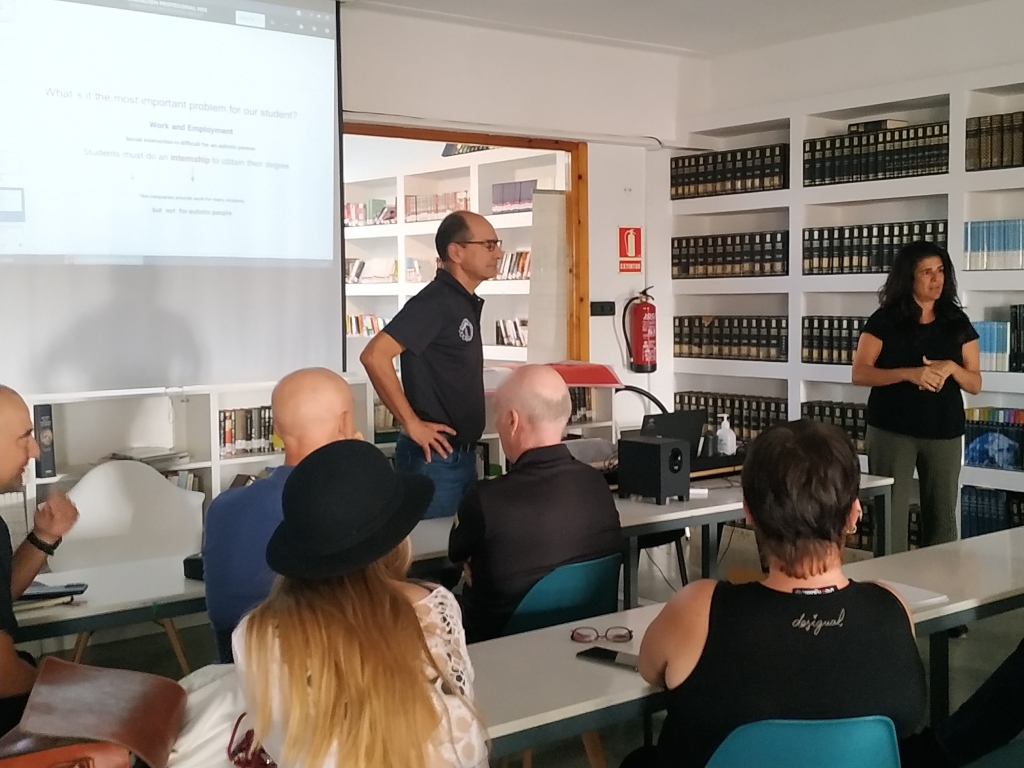
This was followed by a field trip to the VET college, IES Politecnico Jesus Marin in Málaga. The objective of the visit was to get to know a VET Spanish college (centro de Formación Profesional), understand how it is organised, the different VET courses offered and the support available for autistic students.
The visit began with a general meeting with the school Pastoral leaders and VET teachers who deal with autistic students in their classrooms or workshops. The school has around 1800 students, of which 18 have an autism diagnosis. The school has noticed a great increase in recent years of the percentage of autistic students.
It is also worth noting that none of the teachers at the centre had received any specific training on autism. This reflects a general trend in Spain: a recent survey showed that 75% of teachers who had received training on Autism had had to pay for the training themselves! (See article). There is therefore a clear need for autism teacher training in Spain, which justifies the relevance of the Neurodivergent project.
A presentation was given by Felipe from the Pastoral department (Orientador) who explained how VET is structured in Spain. Felipe also confirmed a general trend that all project partners have experienced in their respective countries: that theoretical teaching tends to go well for autistic students in VET but the difficulties are more obvious in workshops, where activities are less structured.
The solution, according to Jesus Marin, is for VET centres to diversify their teaching methods and also to adapt the learning environment to suit the needs of autistic students.
Only 20% of autistic students manage to complete their VET qualification successfully in the Jesús Marin VET centre. Felipe gave several reasons for this:
Lack of reasonable adjustments and necessary curriculum adaptations for autistic students.
Assessment of the students is not being adapted for them and therefore doesn’t reflect their skills. They would require exam adaptations, different deadlines and different evaluation methods.
Students are required to take part in an internship as part of the course which is proving to be a problem area. Private companies tend to show little flexibility and will not consider adapting their working environment to suit the needs of autistic students. Autistic apprentices struggle to adapt to the specific demands and flow of a working day. They struggle to fit in without an inclusive culture in the working place. Often, only public bodies or state administrations will offer placement suitable for their autistic students.
Following this meeting, the team was able to see the students at work while being shown around the different workshops in school including “Sound and Image”, “electronic”, “I.T.”, “Architecture”.
The Neurodivergent Conference
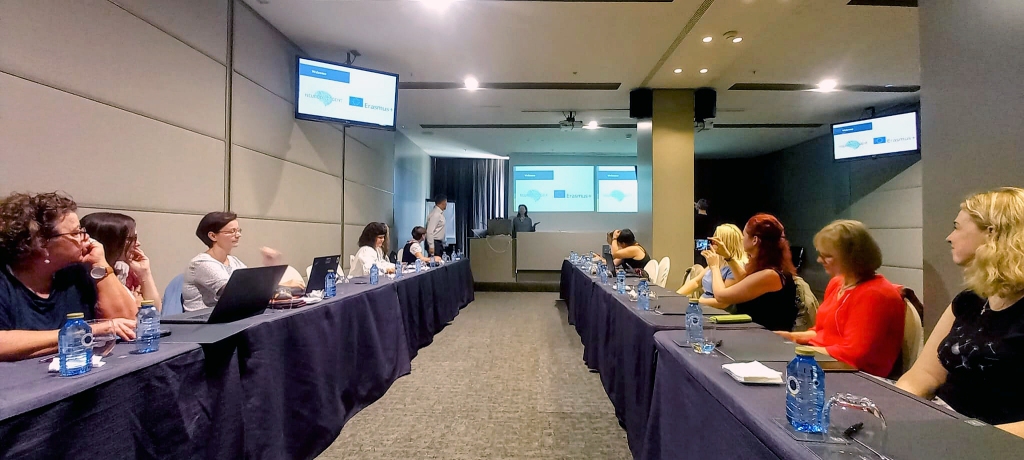
The Neurodivergent Conference took place on the 12th November 2022 in the AC Marriott hotel in Málaga.
The team presented the outcome of their project that will provide professional development for teachers of autistic students in Vocational Education across Europe.
The project team was composed of delegates from partner countries namely: Austria, Belgium, Latvia, Norway, Spain and Sweden. The conference was also attended by other professionals in the field of autism, parents of neurodivergent children as well as teachers and students.
The conference provided a forum to discuss the challenges faced by autistic students within the education system and how schools and teachers might best support them. Presentations from teachers, parents and students ensured that the issues were discussed from a variety of perspectives and points of view.
The Conference Program
Welcome by Marie Pierre Joffre and projectintroduction by Thomas Nielsen The Neurodivergent project aims to equip teachers working in VET with the knowledge and tools they need to better support autistic students.
Marie-Pierre Joffre Student support in Spain and challenges in mainstream education
Dr Martin Persson Autism and body image
Andrea Bennet “Variety is the spice of life”, tips on how to best support autistic students
Ava Brierley A perspective on the school system as a neurodivergent student
Eirini Symeonidou Policy recommendations from a European perspective
Sharing case stories from VET schools and parents Examples from Norway, Spain and Latvia
Q&A session
“We need to educate others, which is why I love this project so much. Education is what led me to understand myself “
Ava Brierley, neurodivergent student at Sotogrande International School, guest speaker at the conference.
2023 And Beyond
The aim of the Neurodivergent autism training is to give teachers a feeling of empowerment and make their life easier in the classroom. It is not to overwhelm them with tedious theory but give them practical tools and strategies that they can implement right away in their VET setting.
As this is highlighted all the way through our training, small adjustments can make a huge difference in the wellbeing and inclusion of autistic students in mainstream school.
For example:
Break down work into smaller steps (difficulties organising and prioritising workload added to a strive for perfection)
Scaffold the task (to lower cognitive and visual overload)
Adapt tests and exams (to take into account processing differences)
Work on their strengths or strong centres of interest (don’t enforce but trigger motivation)
Sadly, many autistic learners are disadvantaged in school and VET (Post 16 settings) because the adjustments needed to best support their learning are not fully understood or in place.
The distressing consequence of unmet needs is that it can often lead to disruptive behaviour and, ultimately, the exclusion or dropout of the autistic student from school or college.
Through this project, we want to help teachers feel able and empowered to support the needs of their autistic learners. And ultimately increase the chances of autistic students thriving in VET settings.
With a few adjustments, some adaptations and a good dose of empathy, autistic students can thrive in school. We are hopeful that the Neurodivergent teacher training will enable us to spread and implement these good practices in VET settings all over Europe.
Clara García, a 15 year old student at Sotogrande International School, conducted an interesting case study on communication skills in neurotypical and Asperger teenagers. Her research, analysis and conclusions reflect the difficulties students with Asperger syndrome face when interacting and communicating with others. A great piece of work Clara, well done!
Dr Camilla Pang has won the prestigious Royal Society science book prize for her study of the complexities of human behaviour seen from an autistic viewpoint.
A neurodiversity advocate with a PhD in cancer bioinformatics, an insightful speaker and author of “ExplainingHumans“, she has written an instruction manual for life from the perspective of someone with autism, ADHD and generalised anxiety disorder.
The prize is intended to “promote the accessibility and joy of popular science books to the public”.
Pang “provides insights into different ways of thinking and the challenges of being neurodiverse in a ‘normal’ world”.
She believes understanding and support can change someone’s life, by seeing what a person is, as opposed to what they should be.







 Asperger Support Spain